 how-to
How to Measure Lingerie Size at Home: 2026 Guide
Table of Contents
- What You'll Need to Measure Lingerie Size at Home
- How to Measure Band Size (Underbust and Ribcage)
- How to Measure Bust Size at the Fullest Part
- How to Find Your Cup Size from the Measurement Difference
- Using a Bra Size Calculator and Size Chart
- Measuring for Panties, Bodsuits, and Shapewear
- Troubleshooting Asymmetry, Between Sizes, and Fit Checks
- Conclusion: Getting the Right Lingerie Size Every Time
- Frequently Asked Questions
Last Updated: October 14, 2026
What You'll Need to Measure Lingerie Size at Home
Getting the right lingerie size starts with one simple tool and five minutes. Learning how to measure lingerie size at home saves you the guesswork of ordering blind and the hassle of returns.
At Glow Pulse Pleasure, we understand the worry about inconsistent sizing charts. Measuring yourself properly and then consulting each brand's chart can help ensure a better fit.
Here is what you need:
- A soft tape measure (the flexible kind used for sewing), ideally 60 inches long
- A mirror, so you can check the tape sits level
- A pen and paper, or your phone's notes app
If you do not have a flexible tape
Use a piece of string, a ribbon, or even a phone charging cable, anything that bends and does not stretch. Wrap it around your body, pinch where the ends meet, then lay it flat against a rigid ruler and read the length. Do this twice; if the readings differ by more than half an inch, start again.
A few checks keep a string measurement honest:
- Use a string that does not stretch. Yarn and elastic cord will lie to you.
- Mark the meeting point with a pen before you take the string off your body.
- Measure the marked string against a ruler on a flat table, not in the air.
If you are measuring alone
Measuring your underbust and bust without help is doable. Use a mirror and a landmark, not a second pair of hands.
- For the underbust, wrap the tape around your ribcage, then turn so you can see your back in the mirror. Check that the tape is level at the back before you read the front.
- For the bust, stand sideways to the mirror. The tape should run straight across your back, not dip or rise.
- For the hips, stand with your feet together and look over your shoulder at the mirror to confirm the tape is parallel to the floor.
If you cannot see your back, measure the front, then hold the tape against your spine at the same height and add the two numbers. This is less accurate, so round to the nearest half inch and treat it as a starting point.
If you have limited mobility or use a wheelchair
Measurements taken seated are still valid, they just need a note. Measure your underbust, bust, waist, and hips seated, and write "seated" next to each number. Look for a seated or adaptive fit guide; many brands now publish one. If the chart only gives standing measurements, add about half an inch to your band and hip numbers.
If you would rather not measure at all
You have two options that do not require a tape:
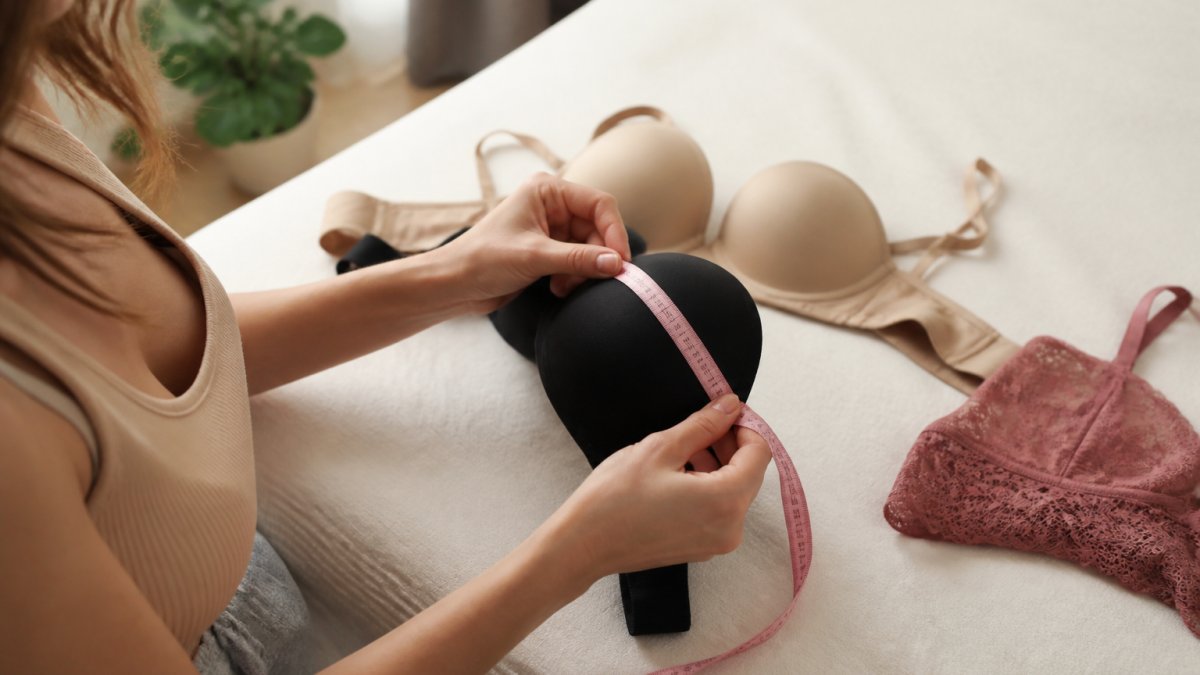
- Try a bra that already fits. Lay your best-fitting bra flat, measure the band from hook to eyelet, and measure the cup depth from the wire to the outer edge. Compare those numbers to the brand's garment measurements.
- Use a brand's fit quiz. Most quizzes ask for height, weight, and current bra size, then estimate from a database. Treat the result as a starting point, not a final answer.
How to Measure Band Size (Underbust and Ribcage)
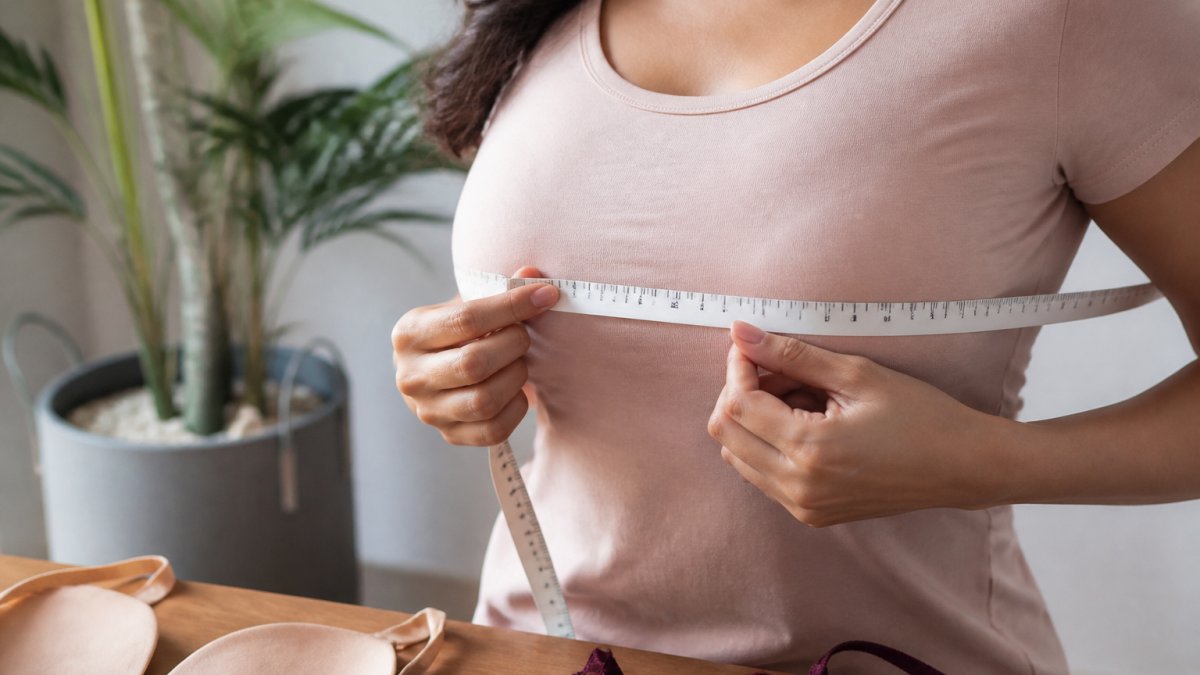
To measure band size, wrap the tape around your ribcage, directly under your bust, and pull it snug.
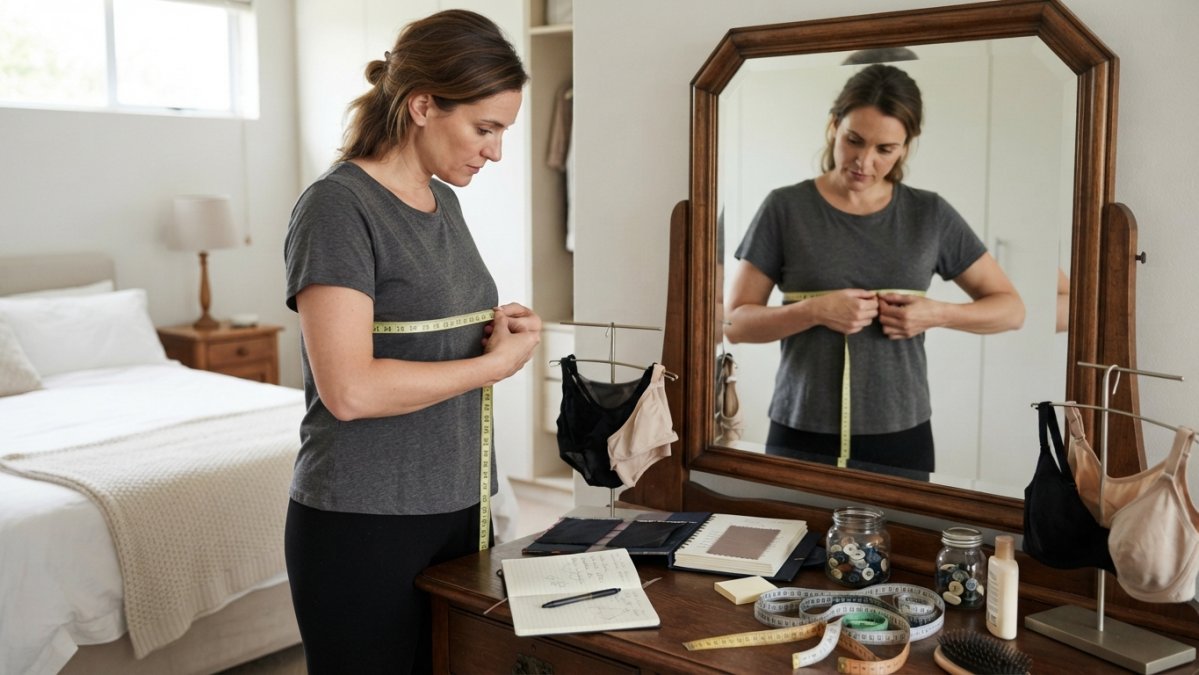
Stand tall and breathe out normally. Keep the tape level and parallel to the floor; if it dips at the back, your reading will be too high.
Write down the number in inches. If it lands on a half inch, round down to the nearest whole inch for a snugger band.
- Tape too loose? The band will ride up later.
- Tape too tight? You will read a band that digs in.
- Tape uneven? Start again with the mirror.
How to Measure Bust Size at the Fullest Part
To measure bust size, wrap the tape around the fullest part of the bust, usually across the nipple line. Keep it level and snug, but do not squash the tissue.
This is the bust measurement, and it is the number most people get wrong. Pulling the tape tight flattens the bust and gives you a cup that is too small.
Check these three things before you read the number:
- The tape runs straight across your back, not angled up or down
- It sits flat against your skin, with no twists
- You are standing straight, arms relaxed at your sides
Round to the nearest whole inch and note it down.
How to Find Your Cup Size from the Measurement Difference
To find your cup size, subtract your band measurement from your bust measurement.
This is the measurement difference, and it is the heart of how cup sizing works. Every inch of difference moves you up one cup letter.
| Difference (inches) | Cup Size |
|---|---|
| Less than 1 | AA |
| 1 | A |
| 2 | B |
| 3 | C |
| 4 | D |
| 5 | DD |
| 6 | DDD |
So if your band is 34 inches and your bust is 37 inches, the difference is 3. That gives you a 34C.
Using a Bra Size Calculator and Size Chart
A bra size calculator does the math for you, but you still need accurate numbers going in.
Most calculators ask for your underbust and bust measurements, then spit out a size. That result is a starting point, not a final answer.
Here is how we suggest you use both tools:
- Take your two measurements fresh, in inches
- Enter them into the calculator to get a base size
- Open the brand's size chart and find your base size
- Note whether the chart runs small, true, or large
- Adjust one size up or down if the chart says so
The Federal Trade Commission's guidance on textile and apparel labeling explains what size information brands are required to provide, which helps you know what to expect on a product page.
For deeper fit standards, the ASTM International standards for body measurement outline how apparel sizing is defined across the industry. And if you want a neutral reference point, the Centers for Disease Control and Prevention's body measurement guidance covers how to take body measurements accurately.
Measuring for Panties, Bodsuits, and Shapewear
Bras get all the attention, but lingerie size covers more than bras. Panties, bodysuits, shapewear, hosiery, and robes each run on different numbers, and most size charts ask for measurements the bra section never touches.
Panties: waist, hips, and rise
You need three numbers, taken over thin underwear or bare skin:
- Natural waist: the narrowest point of your torso, usually just above the belly button. Keep the tape snug but not cinched.
- Hips: the fullest part of your seat, feet together, tape parallel to the floor. This is usually 7-9 inches below the waist for most adults.
- Rise: from your natural waist, down through the crotch, and up to the same point on your back. This decides whether a panty sits at the hip, mid-rise, or high-rise.
Most brands convert those inches into a letter (XS-3X) or a numeric size (4, 5, 6, 7…). Letter sizing often runs on hip measurement alone, while numeric sizing averages waist and hip. If your waist and hips land in two sizes, size to the larger, panties have less stretch recovery than bras.
Bodysuits: torso length is the number that matters
A bodysuit that is too short pulls at the shoulder and rides up through the crotch; too long and it sags. Measure torso length like this:
- Stand straight with your feet together.
- Place the tape at the top of your shoulder, near the base of the neck.
- Run it down the front, through the crotch, and back up to the same point on the shoulder.
- Read the number in inches.
Most bodysuit size charts list a torso range (for example, a small may fit a 28-30 inch torso). If your torso is longer than the range for your usual size, size up, the extra fabric is easier to take in than to let out.
Shapewear: match the compression tier, not just the size
Shapewear is sold in three compression levels, and each changes how you read the chart:
- Light: smoothing only. Stay true to your measured size.
- Medium: visible shaping. Stay true to size unless the chart says otherwise.
- Firm: strong compression. Many shoppers size up one step, because firm garments have less give and can dig at the waistband.
Measure your waist and hips as you did for panties, then check whether the chart uses body or garment measurements. Body-measurement charts are the norm; garment-measurement charts run about 2-4 inches smaller than your body.
Hosiery and robes: two charts people skip
Hosiery is sized by height and weight, not waist or hip. A typical chart pairs a height range (for example, 5'0"-5'4") with a weight range (for example, 100-130 lb) to produce a size like A, B, C, or Q.
Robes are sized by bust and hip for a wrap style, and by height for a long style. For a robe that closes fully across the chest, use your bust measurement, not your band size.
Write these numbers next to your bra measurements. One page in your notes app with band, bust, waist, hip, torso, height, and weight covers almost every lingerie size chart you will meet.
Troubleshooting Asymmetry, Between Sizes, and Fit Checks
Most bodies are not perfectly symmetrical, and that is normal.
If you land between two band sizes, size down in the band and up in the cup, a sister size.
A quick fit check tells you if you got it right:
- The band sits level and does not ride up when you raise your arms
- The center gore rests flat against your breastbone
- The underwire sits on your ribcage, not on breast tissue
If the band rides up, go down a band size. If the cups gape, go down a cup.
One more thing: bodies change. Weight shifts, hormones, and time all move your numbers.
Conclusion: Getting the Right Lingerie Size Every Time
The hardest part of buying lingerie size online is trusting the fit will hold up when the package arrives.
At Glow Pulse Pleasure, we offer a fast, user-friendly shopping experience, clear product details, and a customer service team dedicated to helping when something is not right.
Shop now with Glow Pulse Pleasure and find the fit that finally feels like yours.
Frequently Asked Questions
How do you measure your lingerie size at home by yourself?
Stand in front of a mirror with a soft measuring tape. First, wrap the tape snugly around your ribcage just below your bust to get your band size. Then, measure around the fullest part of your bust, keeping the tape level and parallel to the floor. Subtract your band measurement from your bust measurement to find your cup size. For example, a 2-inch difference equals a B cup, while a 3-inch difference equals a C cup. Write both numbers down before checking a size chart.
Do I add 4 inches to my band size?
No, the old +4 method is outdated. Modern bra sizing uses your actual underbust measurement rounded to the nearest even number. If your ribcage measures 31 inches, your band size is 32. Adding 4 inches usually results in a band that rides up and cups that gap. Trust the tape, not the old rule.
How do I know if I'm an A, B, or C cup?
Cup size comes from the difference between your bust and band measurements. A 1-inch difference is an A cup, 2 inches is a B cup, 3 inches is a C cup, and 4 inches is a D cup. For example, if your band is 34 and your bust is 37, you're a 34C. Always measure at the fullest part of the bust with the tape level. If you're between sizes, try the smaller cup first and check for spillage or gaping.
How often should you remeasure your bra size?
Remeasure every six months, or sooner if your weight changes by 5 pounds or more. Hormonal shifts, pregnancy, and workouts can also alter your band and cup measurements. A bra that fit perfectly last year may now have a band that rides up or cups that spill over. Keep a note of your measurements in your phone so you can compare them before your next lingerie order.