 blog
blog
Best Dame Alternatives for Beginners
Table of Contents
- What Are Dame Alternatives and Why Beginners Should Explore Them
- How to Choose a Vibrator: Key Factors for Beginners
- Best Vibrators for Beginners: Top Picks Across Categories
- Quiet Vibrators for Beginners: Discretion Without Compromise
- Body-Safe Vibrators: Materials and Safety Standards
- Sizing, Fit, and Setup for First-Time Users
- Common Beginner Mistakes and How to Avoid Them
- Frequently Asked Questions
Last Updated: October 17, 2026
What Are Dame Alternatives and Why Beginners Should Explore Them
Dame alternatives for beginners are entry-level intimate wellness products designed for those new to pleasure accessories. At Glow Pulse Pleasure, we know that Dame alternatives for beginners can help starting your intimate wellness journey feel less overwhelming when premium brands dominate the conversation.
Many beginners assume they must choose between expensive, well-known brands or risk buying something that won't meet their needs.
Whether you're curious about vibrators for the first time or switching brands, the best choice depends on what you value most: discretion, intensity, body-safe materials, or straightforward functionality. This guide helps you navigate those choices with confidence.
How to Choose a Vibrator: Key Factors for Beginners
Size and shape affect comfort and control. Smaller vibrators are easier to handle and store; larger ones offer different sensations.
Beginners often assume stronger is better, but many find gentler vibrations more enjoyable and sustainable.
Material safety is non-negotiable. Body-safe silicone, glass, and stainless steel won't irritate sensitive areas. Avoid porous materials that harbor bacteria. This isn't a luxury, it's basic health.
Noise level matters if you live with roommates, partners, or family; quiet vibrators let you explore without anxiety. Battery life and charging also affect usability: USB-rechargeable options offer convenience, replaceable batteries flexibility.
Finally, consider your budget and what features justify that cost. Entry-level products often deliver solid performance without premium pricing. Quality doesn't require spending the most.
Best Vibrators for Beginners: Top Picks Across Categories
Most beginner guides hand you a list of models and call it a day, skipping what actually determines whether you'll like the product: how it fits your body, living situation, and comfort level. Instead of naming brands we can't verify, this section gives you a transparent comparison framework and a decision path by beginner type, so you can evaluate any Dame alternative against the same criteria.
The four criteria that matter most for beginners
Every recommendation below is scored on the same four factors. Use these as your checklist when comparing any product, whether it's a Dame alternative or a first-time pick from another maker.
- Ease of use. One or two buttons beats a ten-mode interface. A beginner should be able to power on, cycle intensities, and power off without a manual; a single power button plus a separate intensity button is the sweet spot.
- Noise level. Look for a stated decibel rating, not just the word 'quiet.' Whisper-quiet should mean barely audible from arm's length. No decibel figure is a gap; read beginner reviews that mention noise in real rooms.
- Material transparency. The listing should name the material explicitly: medical-grade silicone, borosilicate glass, or stainless steel. Vague terms like 'premium material' or 'soft-touch finish' are red flags.
- Value per feature. Compare what you get for the price: rechargeable vs. battery, adjustable intensity vs. fixed, waterproof vs. splash-resistant. A $30 product with three intensities and USB-C charging can outperform a $90 product with app connectivity you'll never use.
Decision path by beginner type
The first-timer who wants low commitment. Start with a compact, single-motor product under $40 with at least three intensity levels and a body-safe silicone exterior, plus a flared base or textured grip for control.
The casual rider who shares a living space. Noise is the deciding factor. Look for a stated decibel rating and a silicone exterior, since silicone dampens motor noise better than hard plastic. A compact form that fits in a nightstand drawer matters as much as the motor.
The progressing beginner ready to upgrade. Once you know whether you prefer gentle or stronger sensation, spending $70-$120 on a wider intensity range, a second motor, or a more ergonomic shape is justified. This is also when waterproofing and travel locks become worth paying for.
What to compare side by side before you buy
Build a five-column comparison before you commit: material, intensity levels, charging method, stated noise level, and price. If a listing is missing two or more of those data points, keep looking. Reputable retailers publish all five; vague listings usually hide a weak motor or unclear material.
Why we don't just list model names
Product availability shifts constantly, and a well-reviewed model may be discontinued or reformulated within a year; a criteria-based guide stays useful longer. When you see a specific product recommended elsewhere, run it through the four criteria and five-column comparison. If it passes, it's worth considering regardless of brand; if it fails on material transparency or noise disclosure, no marketing should override that.
Quiet Vibrators for Beginners: Discretion Without Compromise
Quiet vibrators for beginners remove a major barrier to comfort and exploration. Noise anxiety is real and common: many people hesitate to use a vibrator because they fear being heard by family, partners, or neighbors.
What makes a vibrator quiet? Motor design and material dampening. Higher-quality motors run at lower decibel levels while maintaining power. Silicone construction absorbs vibration noise that plastic amplifies. Thicker walls and internal isolation further reduce sound transmission.
Manufacturers sometimes understate decibel ratings, so real-world reviews from other beginners reveal actual noise in typical situations.
For beginners sharing spaces or prioritizing privacy, quiet options aren't a luxury, they're essential. The confidence that comes from discretion often matters more than the product itself.
Body-Safe Vibrators: Materials and Safety Standards
Body-safe vibrators use materials that won't irritate, harbor bacteria, or degrade over time. This isn't marketing language, it's basic health. Your intimate areas have sensitive skin and delicate microbiomes.
Medical-grade silicone is the gold standard: non-porous, hypoallergenic, and long-lasting.
Avoid anything porous: PVC, rubber, jelly-like materials, or unclear plastics. Porous surfaces trap bacteria even after washing and can develop odors or discoloration cleaning won't fix. The health risk isn't worth the savings.
Beginners often don't know to ask about materials. Reputable retailers specify exactly what their products are made from; vague descriptions are a red flag.
Check for certifications where available. Some manufacturers test for harmful chemicals and phthalates. These certifications aren't required by law, but they signal a company's commitment to safety.
Sizing, Fit, and Setup for First-Time Users
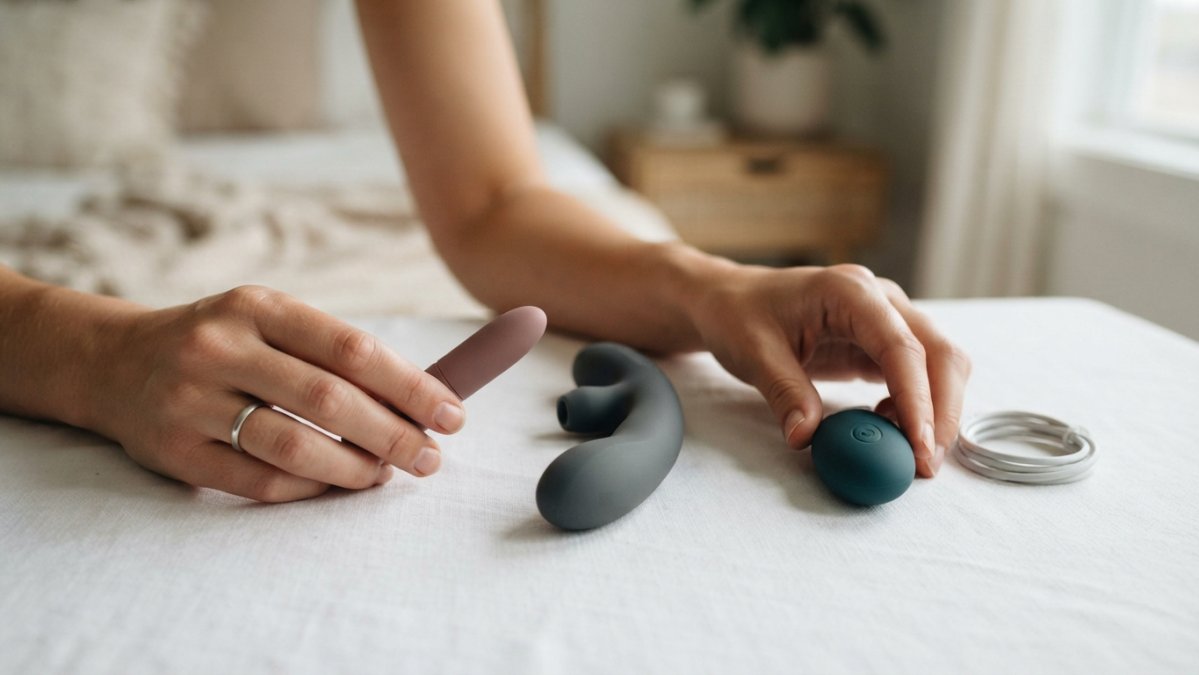
Sizing is where most beginner guides go soft, and it's the question first-time buyers ask most. The honest answer is that there's no universal 'right' size, but there are concrete ranges and a repeatable fit method that make the choice far less intimidating.
Start with these size ranges
For a first product, most beginners are best served by an insertable length of roughly 3 to 5 inches and a diameter of about 1 to 1.25 inches. Those ranges feel manageable for most bodies and leave room to explore larger options later. If you're choosing an external-only product, size matters less for fit and more for grip: look for a body length of 4 to 6 inches so your hand has room to hold it without cramping.
Length and width are separate decisions. A product can be short and wide or long and narrow, and each combination feels different. Don't assume bigger is better or that you need to match a standard. The right size is the one you can hold comfortably and control precisely.
A simple fit check before first use
Before your first session, do a dry run without turning the product on. Hold it in your dominant hand and check three things:
- Grip. Your thumb should reach the controls without shifting your grip. If you have to reposition your hand to change settings, the product is too large or the controls are poorly placed.
- Reach. You should be able to angle the product comfortably without stretching your wrist or shoulder. Discomfort during a dry run becomes worse during use.
- Weight. A product that feels heavy after 30 seconds will feel heavier after 10 minutes. Lighter products with well-distributed weight reduce hand fatigue.
If any of those three checks fails, the product isn't a good fit for you, regardless of how well-reviewed it is.
Setup steps with real specifics
Setup is straightforward, but the details matter more than most guides admit.
- Charge fully before first use. Most rechargeable products ship with a partial charge. The manual should state the expected runtime.
- Read the button map. Even a one-button product usually has a press-and-hold function for power and a short-press function for cycling intensity. Know both before you start.
- Clean before and after. Warm water and mild soap work for silicone. Dedicated toy cleaner is optional but convenient.
- Start at the lowest setting. Most beginners are surprised by how much they enjoy lower intensities. Increase only when the current setting feels predictable rather than stimulating.
When to size up
Give yourself at least a few sessions with your first product before deciding whether to size up. A common pattern is that beginners who start in the 3-to-5-inch range feel ready to explore larger or differently shaped products after a month or two of regular use. There's no schedule to follow; the signal is simply that your current product feels predictable and you're curious about variety. At that point, a second product in a different size or shape is a better investment than replacing the first one.
Common Beginner Mistakes and How to Avoid Them
The most common mistake is buying based on price alone without considering quality or safety.
Another frequent error is overestimating the importance of features. Beginners often assume they need multiple vibration patterns, app connectivity, or advanced settings.
Skipping research about materials leads many beginners astray.
Neglecting cleaning is surprisingly common. People assume intimate products don't need frequent cleaning or use inappropriate cleaners. Proper maintenance extends lifespan and prevents infections.
Comparing your experience to others' expectations creates unnecessary pressure. Your preferences are valid regardless of what online reviews or friends describe.
Many beginners also make the mistake of viewing their first purchase as permanent. It's not. Think of it as an experiment.
Finding the right Dame alternative for beginners doesn't require extensive research or spending more than you're comfortable with.
Frequently Asked Questions
What are the best alternatives to Dame for beginners?
The best Dame alternatives for beginners depend on your priorities: budget, noise level, and body-safe materials. Entry-level options focus on simplicity, single-speed vibration, and ergonomic design. Look for vibrators made from medical-grade silicone, with quiet motors under 50 decibels, and straightforward controls. Glow Pulse Pleasure offers a curated selection of beginner-friendly alternatives that balance affordability with quality, ensuring you find the right fit without overspending on features you won't use.
What should a beginner look for in a vibrator?
Beginners should prioritize simplicity, comfort, and safety. Choose vibrators with one or two speed settings rather than multiple modes, as this reduces overwhelm. Ensure the material is body-safe silicone, which is non-porous and hypoallergenic. Consider size and shape: smaller, curved designs are easier to control. Battery life matters for convenience, and quiet motors allow for discreet use. Waterproof options offer flexibility, and a rechargeable design reduces ongoing costs.
How do you clean and care for a vibrator?
Proper care extends your vibrator's lifespan and ensures safety. Wash with warm water and mild soap before and after use, focusing on all crevices. For silicone toys, use a toy cleaner. Dry completely with a lint-free cloth before storage. Store in a cool, dry place away from direct sunlight, ideally in a breathable pouch. Check the manufacturer's instructions for specific care guidelines. Replace batteries or charge according to the device's specifications.
Are Dame products suitable for beginners?
Dame products are well-designed and body-safe, but they're positioned as premium options with higher price points and advanced features. For absolute beginners, simpler, more affordable alternatives may be better starting points to explore what you prefer before investing in premium models. Once you understand your preferences around size, vibration intensity, and noise level, upgrading to a Dame product or similar brand makes sense. Many beginners find entry-level alternatives from retailers like Glow Pulse Pleasure offer excellent quality at a fraction of the cost.